Wadi El Rayan is where Egypt keeps its only waterfalls, two desert lakes and a valley of fossil whales
Wadi El Rayan is where Egypt keeps its only waterfalls, two desert lakes and a valley of fossil whales
Wadi El Rayan is a protected area in the Fayoum depression, about two and a half hours southwest of Cairo, built around two lakes that should not exist. They were filled in the 1970s with drainage water from the Fayoum's farmland, and where the upper lake spills into the lower one the water drops over a few ledges of rock and becomes the only waterfalls in Egypt. They are low, a handful of feet, and crowded with Cairo families on Fridays. What makes the day is everything around them: dunes running into blue water, the Magic Lake, winter birdlife, springs under a lone mountain, and Wadi el Hitan, the UNESCO valley of fossil whales, an hour further west.
Why there are lakes and a waterfall in the middle of the desert
The Fayoum is a natural bowl west of the Nile, fed since pharaonic times by a canal called the Bahr Yusef. Everything that grows there is irrigated, and irrigation water has to go somewhere. For thousands of years it drained into Lake Qarun at the bottom of the bowl, and by the middle of the twentieth century Qarun was rising, drowning fields and turning saltier every year.
The fix was a second, deeper depression to the southwest, Wadi El Rayan, dry below sea level for as long as anyone had recorded. In 1973 engineers cut a canal and a tunnel from the Fayoum's drains into it. Water filled the Upper Lake first, then overflowed through a short natural channel into a lower basin, and by the early 1980s there were two lakes where there had been a salt flat.
That overflow channel is the point of the story. Water leaves the Upper Lake, runs through reeds and drops over limestone steps into the Lower Lake. That is the waterfall, and its flow rises and falls with the farming calendar. In 1989 the lakes, the dunes, the springs and the fossil beds to the west were declared one protected area: not a park with railings but a big piece of the Western Desert with rules and a few rangers.
The waterfalls, honestly: what you will actually see
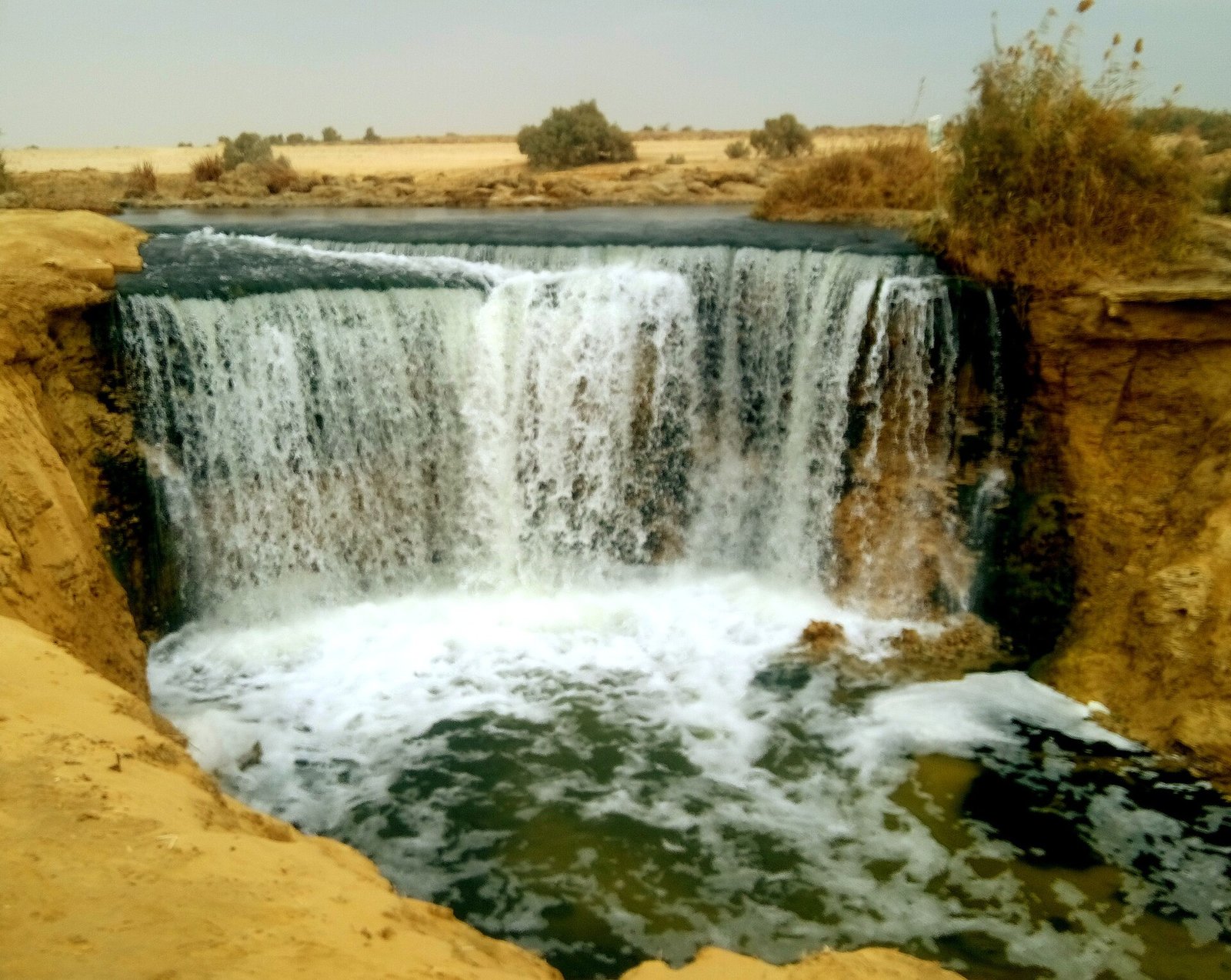
The Wadi El Rayan waterfalls are the most photographed thing in the Fayoum and the most likely to disappoint if you expect a curtain of water. They are a cascade of small drops, the tallest roughly the height of a person, across a channel a few dozen yards wide. The volume has been lower in recent years as the Lower Lake has shrunk and the inflow has been cut back, and in a dry spell they are closer to a lively rapid than a fall.
What makes them worth the stop is the setting. You stand on a spit of sand with the Upper Lake at your back, reeds and date palms on either side, and the water drops into a lagoon so blue it looks tinted, with dunes climbing out of the far shore. Nothing else in Egypt looks like it.
Then there is the crowd. Friday and Saturday are the Egyptian weekend, and on Friday afternoons the falls become a public beach for Cairo and Fayoum families: grill smoke, music from car speakers, kids in the water, rowing boats for hire, tea stalls under reed shelters. Some travelers love it as one of the few places you see Egyptians simply relaxing. If you want it quiet, come on a weekday morning before eleven.
The two lakes and the dunes of the protected area
The Upper Lake is the one the drainage water enters, so it is the fresher of the two, with farmland and a fishing community on its northern shore. The Lower Lake has no outlet, loses water only to the sun, and gets saltier every year. It also has the postcard views, because a long belt of dunes runs down its western side and the sand goes straight into the water without a beach in between.
Off the paved road that ends at the falls, everything is sand track. Distances feel short on the map and long on the ground: the Magic Lake is half an hour from the falls, the springs and Whale Valley about an hour each, and Tunis village forty minutes back toward the highway.
The Magic Lake and the sandboarding dune
The Magic Lake is a small, shallow pool at the foot of the dunes south of the Lower Lake, named for the way its color shifts from turquoise to green to grey as the sun moves. It is fed by seepage rather than by the canal, so the water is warm and still, and Egyptians will tell you the mud along its edge is good for the skin.
The dune beside it is the sandboarding hill. Rent a board at the falls or bring one; the ride takes seconds and the climb is what you remember. The crest is the best sunset spot in the reserve, and small camps set up here for anyone who wants a night in the Egyptian desert without the long drive to the White Desert. There is no shade and no water for sale, and the tracks are soft sand, so this is where your vehicle decides what you get to see.
Birds, gazelles and foxes: the wildlife of Wadi El Rayan
The lakes sit on the flyway that carries birds between Europe and Africa, and from October to March they fill up. Expect ducks and coots in rafts on the open water, grey herons and great white egrets in the reeds, marsh harriers along the shore and the occasional osprey over the Lower Lake. Kingfishers sit beside the falls. Flamingos are more reliable on Lake Qarun, but small groups turn up here too. Bring binoculars; the birds keep away from the picnic zone.
The mammals are harder. The reserve protects the slender-horned gazelle and the Dorcas gazelle, along with the fennec fox and Rüppell's fox, and you will find their tracks around the Magic Lake far more often than the animals. Dawn and dusk are your only real chances, which is one argument for a night in a camp.
The springs of El Rayan
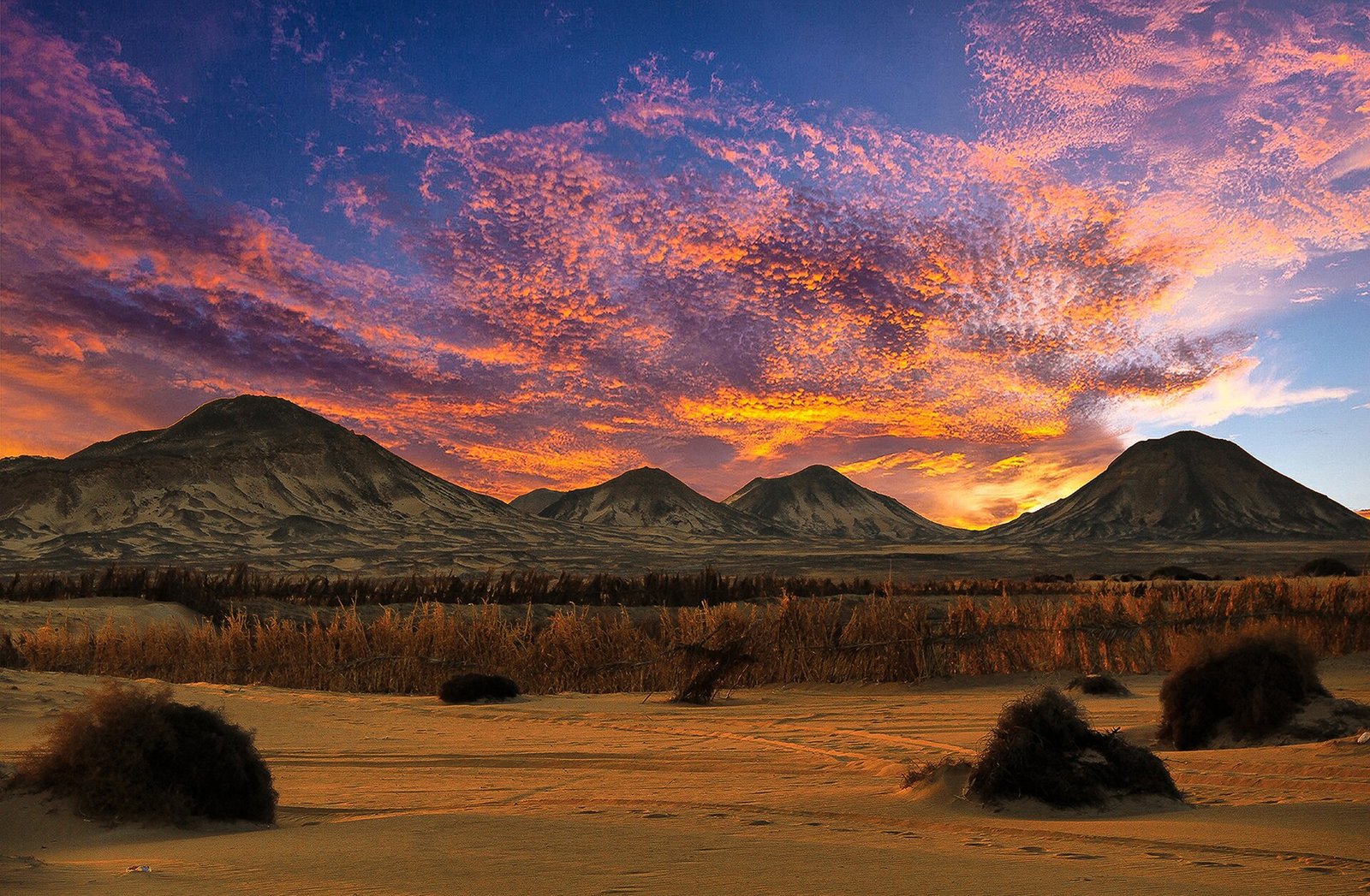
In the far south of the reserve, below the flat-topped Gebel El Rayan, a handful of natural springs rise out of the sand. They are slightly sulfurous and warm, and each has grown its own island of reed, tamarisk and date palm, so from a distance they look like green commas on a blank page. Bedouin families graze goats and camels here, and the ruins of a small Coptic hermitage show how long the water has been known.
The springs take an hour of track each way and are usually the first thing cut from a day trip, a fair call if you want Whale Valley. With two days they are the quiet highlight. The pools are too shallow to swim; the vegetation is what you came for.
Combining the waterfalls with Wadi el Hitan
Wadi el Hitan, Whale Valley, lies in the western part of the same protected area, about an hour from the falls on a road that is paved for most of the way and sand for the rest. Forty million years ago this was the floor of a warm sea, and the sandstone holds hundreds of skeletons of early whales, chiefly Basilosaurus and Dorudon, several with tiny hind legs still attached. It was the first place in Egypt listed by UNESCO for its natural rather than its archaeological value.
The visit is a marked two-mile walking trail between the labeled skeletons, with a small half-buried museum at the trailhead; give it two hours. We cover the site in full in our guide to Wadi el Hitan, the Valley of the Whales. To fit the two together, do Whale Valley first while the air is cool, then the lakes for a swim and lunch, then the Magic Lake and the dune for sunset. Reverse it in winter, when the fossils are pleasant in the afternoon. It is roughly thirteen hours door to door and the best day of nature you can add to a classic Egypt trip.
Tunis village and the rest of the Fayoum
On the way in or out you pass Lake Qarun, the salty remnant of the ancient Lake Moeris, and on its southwestern shore sits Tunis, a village of mud-brick houses and pottery studios that grew up around a Swiss potter who settled there in the 1980s. The workshops sell hand-painted bowls and tiles, there are lakeside places to eat, and it is the natural lunch stop between the falls and the highway.
With a second day you add Karanis, a Greco-Roman town in mud brick with two temples and a museum; the collapsed pyramid of Hawara, beside which the Greeks described the Labyrinth; and Medinet Madi, with the only Middle Kingdom avenue of sphinxes left in the country. Our Fayoum Oasis guide lays out both days, and the region is the easiest piece of Egypt off the beaten path to reach from the capital.
Swimming in the lakes: what is fine and what is not
Yes, you can swim at Wadi El Rayan, and on a warm weekend hundreds of Egyptians do. The lagoon below the falls is the popular spot: shallow at the edge, deeper toward the outflow, with a mild current. The water is agricultural drainage, brackish and not for drinking, and the bottom is mud and reed: a wade-and-cool-off place rather than a clean beach. The Magic Lake is the better swim, warm, still and quiet. Nowhere has a lifeguard, a changing room or a shower.
Dress for the crowd rather than the resort. On a Friday the lagoon is full of families, and a woman in a bikini will draw stares; a T-shirt over a swimsuit and shorts is what local women wear and what we suggest. On an empty weekday morning, wear what you like. Our guide to what to wear in Egypt goes into the reasoning.
Best months to visit, with temperatures
The Fayoum is a few degrees hotter than Cairo in summer and colder on winter nights, and there is no shade in the reserve beyond the reed shelters at the falls. The season runs from October to April, and the sweet spots are late October to November and March to early April, when the water is warm enough to swim, the dunes are walkable at noon and the birds are in.
| Months | Daytime high | Night | What it means on the ground |
|---|---|---|---|
| October to November | 80 to 88F (27 to 31C) | Around 60F (16C) | Warm water, first migrant birds, ideal for the full day with Whale Valley |
| December to February | 65 to 70F (18 to 21C) | 45 to 50F (7 to 10C) | Peak birding, cold for swimming, windy on the dune crest, bring a fleece |
| March to April | 75 to 85F (24 to 29C) | 55 to 60F (13 to 16C) | Best all-round pair of months; a khamsin dust wind can shorten a day |
| May to September | 95 to 105F (35 to 41C) | Around 75F (24C) | Leave Cairo at dawn, be in the water by eight, out of the sun by one |
Summer is not impossible, but Whale Valley in July is brutal by mid-morning. Our best time to visit Egypt guide shows how the Fayoum fits with the rest of the country month by month.
The drive from Cairo and what to bring
From Giza you take the Cairo to Fayoum desert road southwest for about sixty miles, skirt Fayoum city, pass Lake Qarun and run through farmland to the reserve gate, then along a paved road to the falls. Count two and a half hours from a hotel near the Pyramids, and leave by seven so the return misses the evening jam. Any car manages the road to the falls; the Magic Lake, the springs and the last stretch into Whale Valley need a 4x4 and a driver who has done it before. Fill the tank before Fayoum city, and expect no phone signal past the falls.
- Two liters of water per person, more in summer.
- Hat, sunglasses, sunscreen and a long-sleeved shirt.
- Closed shoes for the sand; sandals for the water.
- Swimsuit, a T-shirt to swim in, a towel and a change of clothes.
- A packed lunch; there is nothing to buy beyond tea and chips at the falls.
- Binoculars in winter, a dust cover for the camera, a fleece from December to February.
Leave the drone at home; flying one inside a protected area needs a permit, and equipment has been held at the gate. The other rules are simple: stay on the tracks, take out your trash, and never pick up a fossil or a shell, even a fragment. Fees are paid at the gate and again at Whale Valley; ask us for the current arrangement. The full what to pack for Egypt list covers the rest of the trip.
How Explora Egipto runs the Fayoum day
We run this as a private day from Cairo with our own 4x4, a driver who lives in the Fayoum and knows every soft patch of sand, and a guide who covers both the geology of Whale Valley and the story of the lakes. Water is in the car, the gate fees are handled, and the timing bends to you: birders leave in the dark, families skip the fossils, photographers stay for the sunset.
- Pickup at your hotel around seven.
- Whale Valley by half past nine, trail and museum.
- The waterfalls for a swim, then lunch under the reed shelters or by the lake in Tunis village.
- Magic Lake, sandboarding and the dune crest for the last light.
- Back at the hotel between eight and nine in the evening.
With two days we add the springs, Karanis and a night in a camp or a lodge on Lake Qarun. The Fayoum day slots into any longer itinerary as a rest from temples. See the full range of Cairo excursions for the other options from the capital, then tell us your dates and who is coming and we send you the quote.
Frequently asked questions
Are the Wadi El Rayan waterfalls worth visiting?
Yes, if you go for the setting and not the height. The falls are low, a series of drops about the height of a person, and their flow has weakened in recent years. What you get is water tumbling between reeds into a blue lagoon with dunes behind it, which exists nowhere else in Egypt. With Whale Valley it is one of the best days out of Cairo.
How far is Wadi El Rayan from Cairo?
The waterfalls are roughly ninety miles southwest of the Pyramids by road, about two and a half hours with ordinary traffic. Whale Valley is another hour beyond the falls inside the reserve. A day that includes both runs around thirteen hours from hotel to hotel, so an early start matters.
Can you swim at Wadi El Rayan?
You can. The lagoon under the falls is where Egyptian families swim on weekends, and the Magic Lake is quieter, warmer and shallower. The water is brackish agricultural drainage, fine for a swim but not for drinking, and there are no lifeguards, showers or changing rooms. Swim in a T-shirt and shorts on busy days and bring a towel.
Do I need a 4x4 for Wadi El Rayan?
Not for the waterfalls, which sit at the end of a paved road any car can manage. You do need one for the Magic Lake, the springs and the final sandy stretch into Whale Valley, and more than the vehicle you need a driver who reads soft sand. Most stuck cars we pass are rentals that tried the dunes alone.
Can I see the waterfalls and Whale Valley in one day?
Yes, and it is the day we recommend. Leave Cairo by seven, go straight to Whale Valley while it is cool, walk the fossil trail, then come back to the lakes for a swim, lunch and the Magic Lake in the afternoon. In winter flip the order so the fossils get the warm hours. Adding Tunis village for lunch fits; adding the springs does not.
What is the Magic Lake in Wadi El Rayan?
A small, warm, seepage-fed pool at the foot of the dunes south of the Lower Lake. It changes color through the day as the sun moves, from turquoise to green to steel grey, which is where the name comes from. It is the best swim in the reserve, the sandboarding dune rises beside it, and the dune crest is the place to watch the sun go down.
See the waterfalls, the dunes and the whales in one day
Write to us with your dates, where you are staying in Cairo and whether you want the fossils, the swim or both. We come back with the day laid out hour by hour, the 4x4 and guide confirmed, and a quote in your inbox, from a local agency that has driven these tracks for years.